

Civic Space and the Leaving No One Behind Principle
Civic Space and the Leaving No One Behind Principle
Civil society actors (CSAs) are increasingly confronted with changes in civic space, particularly in contexts of high fragility and rising authoritarianism, where they are exposed to multiple risks and restrictive measures that limit their action capacity. This paper explores how CSAs respond to these changing dynamics and what strategies they employ to continue their critical work in fragile contexts. It also examines the unique challenges CSAs face when representing highly marginalized communities – often the first to be hit by risks.
This document is part of Work Package 3 (Civil Society and Leaving No One Behind) for the Policy Support Programme (PSP) on Fragility and Resilience (REFRACT Project).

The PSP is funded by the Belgium’s Directorate-General for Development Cooperation (DGD) to draw relevant policy suggestions on how DGD can continue its work in the Sahel Region, especially Burkina Faso, Mali, and Niger, which are currently facing a stressful scenario that combines poverty, growing authoritarianism, and extreme vulnerability towards climate change. The central questions driving this paper are: A) How do CSAs navigate changes in civic space, particularly in fragile and authoritarian contexts? B) What strategies are available to different types of CSAs, and how are these implemented in practice? C) What are the implications for CSAs working with or representing marginalized populations whose needs and rights are often ignored or actively repressed? D) How can donors better support CSAs’ agency in fragile contexts? The document provides a preliminary exploration of these questions, drawing from a desk review of pertinent academic research and grey literature on civic space, fragility, and the Leave No One Behind (LNOB) principle.


Est de la RDC : " Les réponses internationales restent incohérentes pour stopper l'escalade du conflit "
Est de la RDC : " Les réponses internationales restent incohérentes pour stopper l'escalade du conflit "
Le 10 août 2024, au moins dix-huit personnes ont été tuées près de la ville de Beni, dans l’est de la République démocratique du Congo (RDC). D’autres massacres avaient fait quatre-vingts morts le 7 juin. Quarante, le 13 juin. De telles attaques sont devenues courantes depuis fin 2013.
Un char détruit à Rugari, après des affrontements entre l’armée congolaise et des rebelles du M23, dans l’est de la RDC, en janvier 2023. GUERCHOM NDEBO / AFP
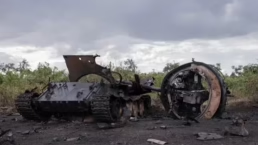
Cette violence spectaculaire est généralement attribuée aux Forces démocratiques alliées (ADF), une rébellion d’origine ougandaise qui a prêté allégeance à l’Etat islamique en 2019. Comme lors de précédentes tueries, aucune force militaire n’est intervenue. Ni l’armée congolaise, ni les forces onusiennes, ni les troupes ougandaises déployées depuis 2021 en Ituri et au Nord-Kivu, et censées lutter contre les ADF.
Cette inaction témoigne de l’agonie de la politique congolaise et internationale qui, depuis les années 1990, ont laissé l’est de la RDC se transformer en cimetière. Cimetière pour les victimes, mais aussi pour les bonnes intentions d’une » communauté internationale » divisée et dont l’intérêt se manifeste surtout quand elle n’a pas d’autres urgences. Comment en sommes-nous arrivés là ?

How the world keeps failing eastern DRC
By Koen Vlassenroot and Christoph Vogel – Published On 26th Octobre 2024
How the world keeps failing eastern DRC
On August 10, at least 18 were killed near the city of Beni, in the eastern Democratic Republic of the Congo (DRC) near the border with Uganda. Two months earlier, on June 7, a massacre had left 80 dead, and another one on June 13 had killed 40 people. Such attacks have become all too common in recent years. The intense violence in this part of eastern DRC has been generally attributed to the Allied Democratic Forces, a Ugandan-origin rebel group that pledged allegiance to the Islamic State in 2019. As with previous massacres, none of the nearby military forces – including the Congolese army, invited Ugandan military or UN peacekeeping troops – intervened to stop the killing.
UN peacekeepers patrol areas affected by attacks by M23 rebels near Rangira in North Kivu in the east of DRC on March 29, 2022 [File: Reuters/Djaffar Sabiti]
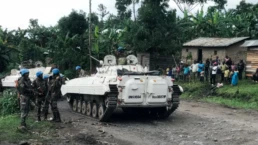
This inaction reflects a broader politics of agony that has turned eastern DRC into a graveyard for thousands of civilians. At its roots is the failure of the mantra of good intentions professed by a divided and distracted “international community”. So, where did it all go wrong?