

Why is there no peace in the DRC?
Why is there no peace in the DRC?
Aymar Nyenyezi Bisoka & Koen Vlassenroot

« On December 10, 2025, the city of Uvira fell to the Rwanda-backed AFC/M23 rebels (United Nations, 2025). This occurred six days after a peace agreement was signed between the DRC and Rwanda under the auspices of US President Donald Trump. Uvira was considered the last barrier to the Congolese government’s stronghold of Katanga. The military threat of a strategic base for Kabilism networks falling into the hands of the rebels has put pressure on Kinshasa and affected political stability. While the rebels have meanwhile formally withdrawn from Uvira, its military pressure remains intact.
The official reactions from Kinshasa to Uvira’s fall—notably those of Patrick Muyaya, Minister of Communication and Media and government spokesperson, and Thérèse Kayikwamba Wagner, Minister of Foreign Affairs—as before stayed largely confined to calls for international condemnation and action. This despite past experiences, which had fully demonstrated the limitations of such an essentially declaratory and outward-looking approach.
On the Rwandan side, the Minister of Foreign Affairs, Olivier Nduhungirehe, followed by the President of the Republic, Paul Kagame, repeated a wellknown trope that responsibility for the capture of Uvira lies with the DRC, which they accuse of cooperating with the FDLR and the Burundian army. The Rwandans allege that AFC/M23’s actions are motivated by the need to protect the Tutsi population, who are framed as victims massacred by Congolese authorities and their armed partners.
Meanwhile, part of the international community repeated rhetorical calls for peace—to respect agreements and prioritize dialogue—that have become tiresome for the victims of war. Some actors, such as United Nations Secretary-General António Guterres, explicitly condemned the AFC/M23 and Rwanda. Others, such as Belgium, adopted a more cautious stance that calls for compliance with existing agreements without clearly identifying those responsible or taking firm measures. Despite a recent and rare firmness from the US government, international efforts have repeatedly proved incapable of producing significant deterrent effects on the ground. The AFC/M23 did announce that it would voluntarily withdraw from Uvira on December 16 under certain conditions and eventually did so in January 2026, which suggests that US pressure is bearing some fruit, though such a political gesture is likely to have little influence on the wider conflict.
All these international actors—whether calling for peace with courage or caution—fail to outline the practical terms for achieving this peace, given the existing balance of power and interests at stake. In other words, recycling pious injunctions and worn-out formulas for peace, does not bring us closer the prospects for peace in the Great Lakes region
In the following pages, we defend three theses. First, unlike previous conflicts and negotiation processes in the DRC, the current sequence is unique due to the drastically reduced options available for negotiation. This impasse stems from the complexity of the conflict, the limitations of the international response, and a global realignment toward a more transactional understanding of peace. Secondly, this narrowing of possibilities leads to two brutal outcomes: either the intervention of a significantly larger military force capable of ending the conflict without provoking a further escalation of violence, or the tacit acceptance of continued regional unrest and the lasting normalization of war. Thirdly, we show why it has become imperative today to impose of a strong peace rooted in sovereignty and the consolidation of a robust state. We argue that the state is the only player capable of articulating competing claims, producing politically negotiable compromises, and subjecting the use of force to constitutional, legal, and international constraints. »

Rapport [en anglais] : Escalation and Restraint in Conflicts in the Democratic Republic of the Congo
Escalation and Restraint in Conflicts in the Democratic Republic of the Congo
Rapport conjoint Ebuteli et ReFrACT

Executive summary
Since mass violence broke out in the Democratic Republic of the Congo thirty years ago, various theories have been put forward to explain the conflict and to find ways to stop it. Some have emphasized minerals; others have placed the onus on the weakness of Congolese state institutions or on meddling by its neighbors. This report serves as a summary of and intervention into this debate as conflict continues to escalate. We make two main points. First, we argue that more attention needs to be paid to restraint, focusing on places and moments when conflict has been ratcheted down, as well as on escalation. This leads us to our second point — that conflict cannot be explained by a single cause. Instead, escalation and restraint emerge from the interaction of political, economic, social, and historical factors. We argue that structural conditions — such as state weakness, unresolved land disputes, elite manipulation, and the legacy of past wars — shape how local triggers ignite into wider crises.
The case of Ituri illustrates these dynamics. Between 1999 and 2005, conflict intensified as foreign armies, ethnic militias, and shifting alliances between Uganda, Rwanda, and Kinshasa converged in the province. A long period of relative stability followed, supported by military pressure, demobilization programs, and local peacebuilding efforts. Yet structural inequalities and unresolved historical resentments allowed violence to resurface in 2017 with the rise of CODECO, whose decentralized organization and spiritual mobilization made de escalation difficult. This account of escalation and restraint suggests that these phenomena cannot be conceived as separate from broader conflict dynamics — interventions such as early warning systems, human rights training, and communal reconciliation projects will have little lasting impact if they are not connected to national and regional frameworks. We conclude that what is above all needed is a national peace process, a framework that can link local peacebuilding to national political processes, strengthen institutions, and bring an end to foreign meddling in domestic conflicts.

Événement REFRACT- « Les dynamiques d’escalade et de retenue de la violence dans l’est de la RDC » 27 février 2026
Événement REFRACT « Les dynamiques d’escalade et de retenue de la violence dans l’est de la RDC » 27 février 2026
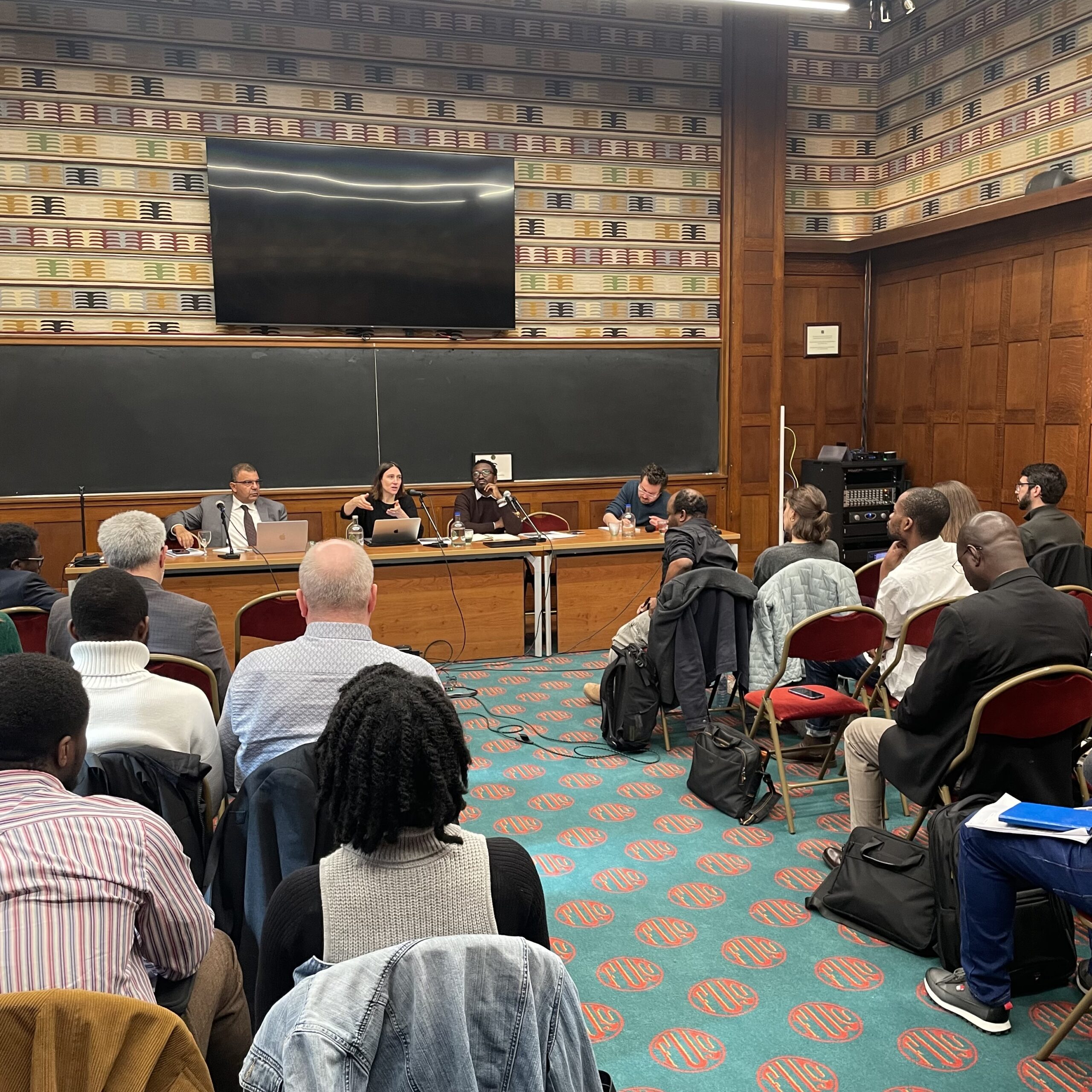


Le Programme d’appui à la politique ReFrACT (Résilience et Fragilité en Action), en collaboration avec Ebuteli (Institut congolais de recherche sur la politique, la gouvernance et la violence), a organisé un événement le 27 février, de 09h00 à 13h00, à la Fondation Universitaire.
Cette rencontre a réuni des chercheurs, des responsables politiques ainsi que des acteurs de la société civile engagés en République démocratique du Congo. Elle a permis de présenter les principales conclusions du rapport d’Ebuteli et de ReFrACT, intitulé « Les dynamiques d’escalade et de retenue de la violence dans l’est de la RDC », diffusé dans sa version anglaise, et de favoriser un dialogue entre les acteurs académiques, les administrations étatiques et multilatérales, et les professionnels de la consolidation de la paix. L’objectif était d’identifier de nouveaux leviers d’action dans les stratégies de réduction de la violence.
L’événement s’est déroulé en deux temps :
Premier panel : « Qu’est-ce qui rend certains conflits violents et d’autres non ? »
Ce panel a exploré les facteurs politiques, sociaux et institutionnels qui expliquent pourquoi certains conflits dégénèrent en violences armées tandis que d’autres restent contenus, et a présenté les principales conclusions du rapport.
Second panel : « Peut-on faire baisser durablement la violence sans résoudre les conflits ? »
Cette discussion s’est intéressée aux stratégies de réduction de la violence à court et moyen terme, aux limites des approches existantes et aux conditions dans lesquelles une baisse durable de la violence peut être envisagée en l’absence d’un règlement politique complet.
Cet échange visait à renforcer la compréhension collective des enjeux et à encourager une coopération plus cohérente entre les acteurs congolais et internationaux engagés en faveur de la paix, de la stabilité et du développement durable dans la région.