

REFRACT Cafe- " Russian Information Operations in the Sahel: A Data-Driven Typology and Analysis" -13 May.
Russian Information Operations in the Sahel: A Data-Driven Typology and Analysis


In recent years, the Sahel region has become a focal point for various information operations, particularly those linked to Russia. As geopolitical tensions rise, it is crucial to investigate how these operations shape narratives and influence local dynamics.
This Cafe featured Professor Stéphane Baele from UCLouvain, who presented his paper titled “Russian Information Operations in the Sahel Region.” This research provided a comprehensive typology of the actors involved in these operations, grounded in a systematic analysis of the digital behaviors and content from over 250 Facebook pages based in Mali, Burkina Faso, and Niger that maintain connections with the Kremlin.
The discussion, chaired by ReFrACT co-lead researcher, Emmanuel Klimis, was complemented by insights from Melissa Lakrib who is currently researching the impact of Wagner’s deployment on the nature of civil war in Northern Mali.
This event aimed to shed light on the complexities of information warfare in the Sahel and discussed the implications for regional stability and international engagement.

Gender Backlash and Rising Authoritarianism in Fragile Contexts
Gender backlash and rising authoritarianism in fragile contexts
Maria Martin de Almagro Iniesta & Madeleine Benson

Gender backlash is a function and facilitator of authoritarian politics, emerging from and exacerbated by perceived or actual crises. Reflecting context-specific social and political dynamics, gender backlash takes a myriad of forms, from overt oppression of women and LGBTQIA+ communities, to strategic genderwashing and cooptation. Understanding how the precarity of gender rights can be exploited towards autocratic ends is essential for effective intervention planning and risk management in fragile settings. The research paper identifies three trends of concerns of gender backlash:(1) discursive opposition to gender equality, (2) social and political oppression of women and Lesbian, Gay, Bisexual, Trans, Queer, Intersex, A sexual and gender minorities (LGBTQIA+), and (3) genderwashing and cooptation. This research paper attends to the fact that where this dynamic coincides with authoritarian leadership and systemic fragility, the implications for development cooperation outcomes are significant. The document provides a preliminary exploration of these key trends, drawing from a desk review of pertinent academic research and grey literature on gender backlash, fragility, and authoritarianism.

Projection film 'Colombes sans Gravité' en avant-première et conférence-débat- 16 et 17 Mai
Projection film 'Colombes sans Gravité' en avant-première et conférence-débat


Comment le conflit au Mali consacre les soldats de la paix en acteurs impuissants de la guerre et pourquoi cet echec annonce un nouvel ordre mondial.
Il y a onze ans, le Conseil de sécurité de l’ONU, dans la continuité de l’intervention militaire française, décidait de l’installation d’une Mission de maintien de la paix au Mali, la MINUSMA. Les forces internationales devaient stabiliser le pays, aider à rétablir le fonctionnement démocratique et éliminer la menace djihadiste.Depuis, cette dernière ne s’est jamais autant étendue au Sahel, ce qu’il reste d’État au Mali s’en est remis à un groupe de mercenaires russes et la France, ancienne puissance coloniale, a été poussée dehors puis ensuite les Nations-Unies. Plongé au cœur des instances opérationnelles et décisionnelles de la mission des Nations-Unies au Mali et à New-York, éclairé par le témoignage d’acteurs directs, COLOMBES SANS GRAVITÉ voyage aux sources de l’échec pour questionner le modèle interventionniste international, les illusions perdues des solutions de paix et des processus politiques, à l’heure où la multiplication des conflits asymétriques à forts potentiels de contagion laisse craindre le retour de confrontations globales.
Ce documentaire a été présenté en première mondiale en novembre dernier à Columbia University, à l’invitation de Jean-Marie Guéhenno. Depuis, le film a été projeté lors de séances spéciales dans des cinémas.
Les séances au Cinéma Aventure de Bruxelles les vendredi 16 (19h) et samedi 17 (16h) mai 2024 ont été organisées à l’initiative du Centre de recherche en science politique (CReSPo) de l’UCLouvain Saint-Louis-Bruxelles, en collaboration avec le PSP REFRACT et l’APNU. La projection a été suivie d’une conférence-débat d’une heure, en présence du réalisateur et d’experts, et prolongée par un drink.
L’information a été diffusée à large échelle et le public a été nombreux à y assister.

L’échec d’une tentative de « stabilisation » au Sahel
L’échec d’une tentative de « stabilisation » au Sahel
Tanguy Quidelleur

Since 2012, the Sahel has been at the center of a regional conflict characterized by the failure of international interventions and “stabilization” practices. Largely driven by imaginaries of state reconstruction and counterterrorism, these policies have ultimately accompanied local dynamics of violence and political polarization. The rise of authoritarianism, illustrated by recent coups d’état, reflects a rejection of interventionist models perceived as externally imposed and redefines power relations at the regional level. In this context, West African actors play a central role in reinterpreting governance practices but, more importantly, in fostering new alliances and intensifying competition among interventionist powers. This policy brief offers a sociological and critical analysis of the limitations of international strategies, highlighting the differentiated effects of interventions on local social and political structures. Finally, it explores the prospect of a renewed international engagement that is more attuned to local dynamics and ongoing sociopolitical transformations.

The Contribution of the Penal System in the Fight Against Corruption in Burkina Faso- 18 Mars 2025
The Contribution of the Penal System in the Fight Against Corruption in Burkina Faso


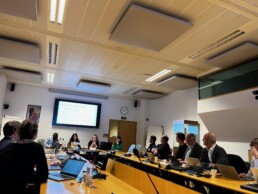
"The implementation of the Humanitarian-Development Peace Nexus in the DRC"- 07 April 2025
"The implementation of the Humanitarian-Development Peace Nexus in the DRC"


Description of the event :
As one of the most ambitious frameworks to date, the Triple Nexus seeks to bring together security, development, and humanitarian sectors to more effectively coordinate, finance, and respond to complex crises and conflict situations. According to the OECD (2019:6), the approach aims to “leverage the strengths of each sector… to reduce vulnerability, improve risk management, and tackle the underlying causes of conflict.” But what is needed for the successful implementation of the Triple-Nexus and integrated capacity-building across the spectrum of insecurity? How do we best leverage defense and security actors’ expertise in implementing the Triple-Nexus? This REFRACT Café explores these questions and the implementation of the Triple-Nexus in the DRC. Based on empirical examples and with a broad historical, geographical, and social perspective, Prof. Muzalia examines the evolution of humanitarian and development logics in the DRC: scattered humanitarian interventions, privileged zones and domains of intervention and the HDP nexus. He will then examine how this has transformed the affected areas and identify some of the challenges that must be overcome in order to improve interventions. Prof. Swedlund will discuss the results of a research project that studied the implementation of the Triple-Nexus across three Congolese provinces—Kasai, Kasai Central, and Tanganyika. The project’s core objectives are: (1) identifying the most promising practices for integrated capacity-building, and (2) comparing alternative approaches for integrating defense and security actors, including in partnership with UN missions.